welcome to TECHNO WORLD

Sunday, 23 March 2014

A new programming Language Introduced by Facebook - { hack }


Facebook has just released [ Introduced ]  a new programming language called 'HACK', designed to build complex websites and other software quickly and without many flaws and also the main motive of decreasing resource conservation. The company has already migrated almost all of its PHP-based social networking site to HACK over the last year, but it has nothing to do with Hacking.

Facebook :- 
Today we're releasing Hack, a programming language we developed for HHVM that interoperates seamlessly with PHP. Hack reconciles the fast development cycle of PHP with the discipline provided by static typing, while adding many features commonly found in other modern programming languages.
We have deployed Hack at Facebook and it has been a great success. Over the last year, we have migrated nearly our entire PHP codebase to Hack, thanks to both organic adoption and a number of homegrown refactoring tools.
We're also proud to release an open source version of Hack to the public at http://hacklang.org/ as part of our HHVM runtime platform, which will now support both Hack and PHP.

Download Link:- http://docs.hhvm.com/manual/en/install.php 


Official site :- http://hacklang.org/


Thus, Hack was born! Facebook Team decides to develop a new programming language that could combine elements of static-type programming languages such as C or C++ with dynamic-type languages like PHP, now called "HACK Programming Language".

"Hack has deep roots in PHP. In fact, most PHP files are already valid Hack files." Facebook said, "We have also added many new features that we believe will help make developers more productive."

HACK is a new version of PHP, requires Facebook’s HHVM (Hip Hop Virtual Machine) which is designed to execute programs written in Hack and PHP. The top 20 open source frameworks on Github run on HHVM.
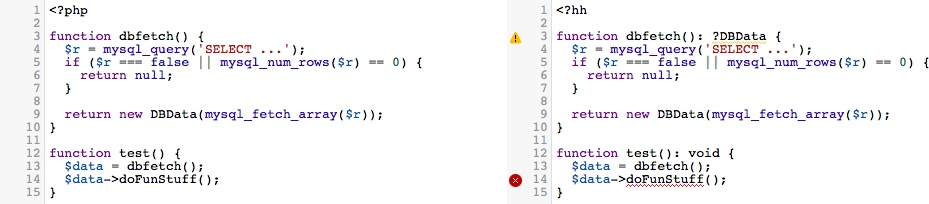


by Facebook's - { hack } official site  :- 
The following are some of the important language features of Hack. For more information, see the full documentation, or follow through the quick interactive tutorial.
  • Type Annotations allow for PHP code to be explicitly typed on parameters, class member variables and return values:
<?hh
class MyClass {
const int MyConst = 0;
private string $x = '';
public function increment(int $x): int {
$y = $x + 1;
return $y;
}
}
  • Generics allow classes and methods to be parameterized (i.e., a type associated when a class is instantiated or a method is called) in the same vein as statically type languages like C# and Java):
<?hh
class Box<T> {
protected T $data;
public function __construct(T $data) {
$this->data = $data;
}
public function getData(): T {
return $this->data;
}
}
  • Nullable Types are supported by Hack through use of the ? operator. This introduces a safer way to deal with nulls and is very useful for primitive types that don’t generally allow null as one of their values, such as bool and int (using ?bool and ?intrespectively). The operator can be used on any type or class.
  • Collections enhance the experience of working with PHP arrays, by providing first class, built-in parameterized types such as Vector (an ordered, index-based list), Map(an ordered dictionary), Set (a list of unique values), and Pair (an index-based collection of exactly two elements).
  • Lambdas offer similar functionality to PHP closures, but they capture variables from the enclosing function body implicitly and are less verbose:
<?hh
function foo(): (function(string): string) {
$x = 'bar';
return $y ==> $x . $y;
}
function test(): void {
$fn = foo();
echo $fn('baz'); // barbaz
}
Other significant features of Hack include Shapes, Type Aliasing, Async support, andmuch more. 
Stay tuned to +Techno World  for more Technology updates  


Sunday, 16 March 2014

Download Beta VLC Player for Winodws - 8 & Windows 8 RT


VLC now available for Windows 8 one of the best multimedia players has finally come to Windows 8 and Windows 8 RT. A few hours ago that they have posted on the official blog announcing a beta version, but perfectly functional.

VLC for Windows 8 development has been paid thanks to a round of funding on Kickstarter that got nearly $80,000. The application is tailored to the interface ModernUI that characterized the new generation of Windows and can be downloaded directly from the app store.

The usual VLC in other systems notice less fluid than usual operation and some minor problems to work with subtitles, while taking into account that we are talking about a beta, developers work is more than notable. A year later, Windows 8 users can now enjoy great VLC. this is given in VLC's one of the blogpost

Today, the first Beta of VLC for WinRT is getting deployed on the store.
As many of you know, the road to come to this point has been long... Very long.
I've been driving or helping some ports of VLC on mobile, but this port has been the hardest, by an order of magnitude.
I'll speak a bit more about the lateness of this port, another time. Today, I'll introduce a bit to this application.

Features

This application, version 0.2.0, is a BETA stage of the port of libVLC on WinRT. WinRT is the runtime of Windows 8/8.1 Metro/ModernUI, Windows Phone 8 and Xbox 1.
As this is a beta, some features are still not perfectly stable, but we are working on that. We thought we should share it with the users, so that people could test and help us.
This application:
  • works on Windows 8.0 and 8.1: too many people are still on 8.0, so we had to use that. This decreases the stability of the application, though...
  • is compiled for Intel x86 CPUs: Windows RT version will follow as soon as we are able to compile it. ARM version will also apply to Windows Phone.
  • plays all video and audio formats of VLC, including MKV, Ogg and Mov files or FLAC and MPC;
  • supports the same codecs as the VLC application for desktop, from MPEG-1 to H.265, through WMV3 and VC-1;
  • supports multiple-audio tracks selection;
  • supports embedded subtitles;
  • supports Background Audio playback;
  • features a easy-to-navigate but complete UI, notably for audio browsing;
  • supports Live Tiles!
  • supports removable storage and DLNA servers.
However, there are a few limitations:
  • This app is currently slow, and is slower than VLC for desktop for video decoding and has no hardware acceleration;
  • Subtitles support is not very good yet, and notably it only supports embedded subtitles; this is our major point of focus for now.
  • Audio does not seem to work in all configurations;
  • Playlists and streams are not supported in the UI (they are present in the core)
  • It's clearly not as stable as it should be.
We are working on all those points, but notably on subtitles and audio quality and stability. Since we now have a release, it will be easier to do releases quite often, as soon as we can.
We also have longer terms goal to work on, and we'll share them when we know more :)
We hope you like this application, and if you don't, we'll fix that soon :) 

Download :


Wednesday, 5 March 2014

Micromax Canvas Knight A350 review: Octa-core phone for Rs 19,999


First things first. This is a phone from Micromax, but it does not look like a phone from Micromax. In fact, it looks like a phone from a well-heeled international brand, the sort that Micromax wants to become in the near future. This is the Micromax Canvas Knight, the phone that will take over the flagship mantle for the company from today.
Quick Tech Specs: 5-inch IPS display (1920×1080 pixels, 443 ppi) | 2GHz Tru Octa core MediaTek MT MT 6592 processor | 2GB RAM | 32 GB storage + no microSD slot | 16MP rear camera, 8MP front camera, 1080p Full HD video | 3G, Wi-Fi 802.11 b/g/n, Bluetooth 4.0 | 2350mAh battery | Android 4.2 JellyBean
Price: Rs 19,999

Design: As I said this phone does not look like a Indian phone. In fact, it has the cuts and sides of the Apple iPhone 5s and even reminded me a bit of the Lava Iris Pro 30, which also had a similar design language. The unibody design is reinforced by what seems, and feels, like a graphite frame. There are mico-SIM slots on both sides that can be accessed by a pin. And, no there is no space for a SD card. Another thing that sets this phone apart is the power key, that is now placed along with the volume keys on the right. This take a bit of getting used to.

The camera, the 16 MP sensor that it houses, results in a significant bump on the rear and there is an extra rear cover to sort of protect it. This feature is a bit like the one on the Nokia Lumia 502 and it becoming common in slim phones with large cameras. The phone is very light and easy to handle despite the large screen.
Screen & Audio: The Full HD IPS panel is one of the best features of this phone. To start with, there is hardly any light bleed on the sides. The phone can be bright enough to be legible in bright sunlight. The audio quality is good, but not great. The overall experience, however, is quite good.
Performance: This is a Tru Octa core phone. So performance should not be, and is not, and issue at all. In fact, the Antutu benchmark scored it in the top draw and exclaimed ‘amazing’. Yes, that doesn’t mean much for an average used. What matter for him is the fact that there is no lag anywhere and that multi-tasking is a breeze. We tried multi-tabbed browsing on Chrome and the experience was superb. However, with some games we noticed that the device did heat
Micromax has officially launched the Canvas Knight Smartphone in India for Rs 19,999. The company launched this device first in Russia while it launched its operations there. Micromax Canvas Knight is the company’s first Octa-Core smartphone and also the first to have 16-MegaPixel camera on board. This device comes with a powerful 2GHz Octa-Core MediaTek processor coupled with 2GB of RAM.
This smartphone is the most advanced and the best one from Micromax till now. The design of the device looks inspired from iPhone 5 but what it does different is have different layout and larger screen. It sports a 5-inch multi touch HD display with a resolution of 1920x1080 pixels with an amazing pixel density of 443 pixels per inch.
This smartphone come with Android 4.2.2 Jelly Bean Operating System and is expected to get Android KitKat Update soon. Other features of the phones include a 16-MegPixel camera on the rear side with LED flash and Autofocus for photography and a 5-MP front facing camera for Video calling. This smartphone uses a 2,350mAH battery for the power supply. Previously the company launched the Canvas Turbo and Canvas Turbo Minismartphone with amazing price and features.


Monday, 3 March 2014

Google’s Project Ara of a Modular Smartphone Could Start at $50

Last year, designer Dave Hakkens positioned the concept of a modular smartphone--or Phonebloks--as a way to cut down on the electronic waste of handsets. Motorola would go on to work with Phonebloks to eventually bring the idea to fruition, with the end result being Google's Project Ara. And according to a report from Time, these customizable phones could be out next year for an incredibly affordable price point.


"The smartphone is one of the most empowering and intimate objects in our lives," said Paul Eremenko, who heads up Project Ara for Google ATAP. "Yet most of us have little say in how the device is made, what it does, and how it looks." Interestingly, the Advanced Technology and Projects (ATAP) group was one sector Google kept following the sale of Motorola to Lenovo.
Google thinks Project Ara could offer an entry point into the smartphone market for emerging regions, citing the over five billion people in the world who are still without one. According to the Time report, Google wants Ara smartphones on the market by 2015, for as little as $50.
On January 29, Google announced that it had agreed to sell Motorola, its phone-manufacturing business, to Chinese electronics giant Lenovo. Thus concluded the company’s brief, unprofitable foray into smartphone hardware, which began when it revealed plans to acquire Motorola Mobility in August, 2011.
Granted, the $50 handset will only have base features--perhaps even lacking cellular functionality--but it's still an interesting starting point. Since users could swap out the modules for better features at whim, Ara has the potential to be a fully customizable, truly affordable smartphone.

The current plans call for three different sizes of modular smartphones, from the $50 mini up to a large phablet. And given the opportunity for unique modules, there's no telling what developers may dream up. Google will host a series of developer conferences for Ara, beginning in April. But anyone can check the devices out, thanks to a free live-stream.

Except that it didn’t really end there. It turned out that Google was holding onto one organization within Motorola: the Advanced Technology and Projects (ATAP) group. Headed by Regina Dugan, the former director of the U.S. Defense Department’s fabled Defense Advanced Research Projects Agency (DARPA), ATAP aims to bring the same approach to mobile-gadget innovation that DARPA used to kickstart the Internet, satellite navigation, stealth fighters and other technologies that started small and eventually mattered a lot.
In retrospect, it’s completely logical that Google would choose to retain ATAP. The technologies and projects it specializes in are the wildly audacious ideas Google likes to call moonshots. The company already has another group devoted to such efforts — Google X, which is working on Google Glass, self-driving cars, broadband balloons and more — but it’s hard to imagine it handing off any moonshots in progress to Lenovo or anyone else.
Among the ATAP initiatives that have been announced, one in particular is quintessentially Google-y. It’s Project Ara, which aims to reinvent the smartphone by breaking it down into modules that can be assembled and customized in a limitless number of configurations. The company first disclosed that the project existed on October 29 of last year, when it released some intriguing photos but little in the way of concrete details. Today, it’s lifting the veil further as it prepares for an Ara developer conference it’s holding at Silicon Valley’s Computer History Museum on April 15-16. A year or so from now, it hopes to have a product on the market.


Monday, 24 February 2014

Sony Xperia Z2 a next level Gadget with 5.2-inch display, and built in Camera captures 4K ultra-HD recording launched

 
Sony Corp. is borrowing innovations from its audio and camcorder businesses and incorporating its new Xperia Z2 smartphone with noise-canceling technology and ultra-high-definition video recording.
Noise cancellation works with an in-ear headset sold separately, while the Z2's built-in camera can capture video in so-called 4K resolution, an emerging standard that offers four times the details as current high-definition video.
"With Xperia Z2 we have taken our premium Z series to the next level, delivering unique experiences that only Sony can offer," Kunimasa Suzuki, Sony Mobile's president and CEO, said in a statement.
Monday's announcement at the Mobile World Congress wireless show in Barcelona, Spain, comes just weeks after Sony said it was selling its Vaio personal computer operations and making its Bravia TV business a subsidiary company. Sony also plans to cut its global workforce by about 3 percent, or 5,000 people, by the end of March 2015.
Sony, once an electronics powerhouse when its Walkman music players defined what portable gadgets should be, has had difficulty keeping up with Samsung and other rivals in various consumer electronics.
Phones are no different. Despite favorable reviews, Sony phones haven't had much traction in an industry dominated by Apple Inc. and Samsung Electronics Co.
With the Z2, Sony is trying to innovate on hardware, while many of the groundbreaking features in rival devices have been in their software.
The Z2 sports the same 20.7 megapixel camera found in its predecessors, the Z1 and the Z1s. Most other smartphone cameras have 8 to 13 megapixels. The Z2 is waterproof, like the Z1 phones, and its screen is slightly larger, at 5.2 inches diagonally instead of 5 inches.
Sony also announced a high-end tablet and a separate, mid-range smartphone.
The tablet is also called the Xperia Z2 and features a 10.1-inch screen, larger than most full-size tablets. It is also waterproof. The Wi-Fi-only model weights 426 grams (0.94 pound), which is lighter than Apple's lightweight iPad Air, despite the Z2's larger size.
Sony's Xperia M2, meanwhile, is meant as a cheaper alternative to the Z2. Its camera isn't as powerful, at only 8 megapixels, and the screen is only 4.8 inches.
Sony is making a version of the M2 with two SIM card slots, something in demand in emerging markets, where plans vary so much that people often have service with multiple carriers and use what's most economical for the circumstance.
Both Z2 devices will be available in March, while the M2 is slated for April. Sony did not immediately announce prices or specific U.S. plans. Sony sometimes makes phones available in the U.S. later than elsewhere around the world.
Sony also took the wraps off its latest premium tablet, dubbed Xperia Z2 Tablet and mid-range Xperia M2 smartphone, at MWC 2014 in Barcelona.


Friday, 21 February 2014

Google's - new Project " Tango! " bringing real 3D technology to smartphones


Google announced a new research project Thursday aimed at bringing 3D technology to smartphones, for potential applications such as indoor mapping, gaming and helping blind people navigate.
The California tech giant said its "Project Tango" would provide prototypes of its new smartphone to outside developers to encourage the writing of new applications.
Project leader Johnny Lee said the goal of the project, which incorporates robotics and vision-processing technology, is "to give mobile devices a human-scale understanding of space and motion."
"What if you could capture the dimensions of your home simply by walking around with your phone before you went furniture shopping?" Google said on its Project Tango web page.
"What if directions to a new location didn't stop at the street address? What if you never again found yourself lost in a new building? What if the visually impaired could navigate unassisted in unfamiliar indoor places? What if you could search for a product and see where the exact shelf is located in a super-store?"
The technology could also be used for "playing hide-and-seek in your house with your favorite game character, or transforming the hallways into a tree-lined path."
Smartphones are equipped with sensors which make over 1.4 million measurements per second, updating the positon and rotation of the phone.
Partners in the project include researchers from the University of Minnesota, George Washington University, German tech firm Bosch and the Open Source Robotics Foundation, among others.
Another partner is California-based Movidius, which makes vision-processor technology for mobile and portable devices and will provide the processor platform.
Movidius said in a statement the goal was "to mirror human vision with a newfound level of depth, clarity and realism on mobile and portable connected devices."
"Google has paved the future direction for smart mobile vision systems and we're excited to be working with a company that shares our vision to usher in the next wave of applications that fundamentally alter how a mobile device is used to experience the world around us," said Remi El-Ouazzane, chief executive of Movidius.
"Project Tango is truly a groundbreaking platform and we look forward to seeing the innovation the developer community achieves," he added.


Wednesday, 12 February 2014

Yamaha is ready to preparing R15 Version 3 and a big FZ updates for India

We  have learnt from our sources that Yamaha plans to launch one more scooter before it shifts focus back to motorcycles. Yamaha says the volumes are important and being in the scooter space and consolidating its success and sales growth is critical.
To that end, the company has oft late, been reluctant to talk motorcycles lest the message about Yamaha scooters be diluted. That, however, is set to change.
We understand that while the R25 is still some time away (and we think the IndianR25 may not have that international parallel twin engine), Yamaha is working hard to bring to market a new R15 V3.
Yamaha has only rolled out one significant update in the entire history of the R15 and we believe 2014 is when the second update comes. We believe that there will be updated styling and bits but the significant update will be a change to the the ECU which will bring most likely a smoother, fatter torque curve and perhaps a minor rise in power. There is no official word on this motorcycle’s launch plan, but we believe Yamaha will have this on sale before the festive season this year.
Yamaha is also working on an update for the FZ and contrary to the rumours of a 250cc FZ, what we are likely to get is some styling updates – see the FZ concept images for the sort of look we are talking about and a larger engine, perhaps 165-170cc for more torque and power. If Yamaha rolls this out at the same or similar price tag, then the FZ, which is a popular motorcycle in the 150cc segment, should see its popularity reignited.


Saturday, 8 February 2014

Apple currently plans to release iOS 7.1 in March and the very next content with Images shown you the proof of iOS 7.1 beta 3 version ready to release official downloads for Apple

iOS 7.1 is currently scheduled for release in March, according to 9to5Mac. The long-awaited update is said to include numerous bug fixes and slight tweaks to iOS 7's user interface. Apple recent distributed the fifth beta of iOS 7.1 to registered iOS developers, so 9to5Mac's timeframe isn't by any means unreasonable. The site previously reported on some of the visual changes included in the betas so far; Apple has made small changes to the dialer, Music app, and users also now have the option of turning off wallpaper motion, or the "parallax" effect, while keeping folder animations turned on.

Perhaps more important than any visual changes, iOS 7.1 is also said to contain significant bug fixes. Apple previously said it was working on a fix for an issue that's been causing devices to randomly reboot since the launch of iOS 7 almost five months ago. Users can likely look forward to those stability improvements in iOS 7.1. 9to5Mac says that Apple isn't planning any other major surprises for the release, however. The site speculates that Apple may choose to announce the update during a press event next month — which may also serve as the introduction of a new Apple TV set-top box.

here the Given info from other site as i mentioned above which shows you the complete details that iOS 7.1 UI's with some screen shot images of it's dev version . so now we can get to download that beta to standard and official release by Apple on March 2014. 


Apple released the third beta of its iOS 7.1 software (build 11D5127c) to registered developers today. Apple released the first iOS 7.1 beta for developers in November bringing with it a handful of UI tweaks, performance improvements, and accessibility features. That release was followed by a second iOS 7.1 beta in mid-December which brought button shapes as an accessibility feature as well as a calendar design mirroring iOS 6 and prior.
We’ll update you of changes as we come across them. Leave us a note in the comments or at tips@9to5mac.com if you find something interesting as well.

-Tweaked Phone, Messages, and FaceTime icons (darker, less harsh like current call banner in 7.1 beta 2)                                                                                                                                                                                                                    
-Parallax can be disabled for wallpapers (found when setting new wallpaper) [my wallpaper]
-Phone now has a new dialer and answer UI (lots of circles)
-New (richer) Repeat and Shuffle buttons
-New power off UI
-New dialogue in Safari ‘Search or enter an address’ now reads ‘Search web or enter site name’
-New ‘New’ button for creating iTunes Radio stations in Music
-New reduce white point option in accessibility contrast settings

-New backspace/shift highlights (Thanks Daniel) and bolder keyboard as seen below: