welcome to TECHNO WORLD

Thursday, 15 May 2014

Huawei Ascend P7 With an 8MP Front-Facing , 13 MP Rear Camera & 5 inch Hd display


Here’s good news for smartphone lovers. Huawei has at last announced the arrival of the successor to last year’s Ascend P6, Ascend P7. Yes, the wait is finally over and though it comes with an equally exceptional price tag, it has created the desired buzz in the market and people are enthusiastic about its features. It features high-end connectivity all of which is packed into its 6.5 mm size.
According to its website and press release, it is supposedly the most slender smartphone in the 4G category in the world. Much research and aesthetic input have gone into the making of this smartphone and the end result is very satisfying for the company. Huawei Ascend P7 has been designed keeping in mind the arches and twists of dewdrops, which gives the phone a fresh natural feel and also helps in the grip of the phone. The phone has a 5 inch HD (1920 x 1080 pixel) display and is powered by a 1.8 GHz quad-core Huawei Kirin 910T processor coupled with 2GB of RAM and 16GB of internal memory. The handset has an 8 MP rear camera which has been designed for the younger selfie-conscious crowd.
The vice president of the company had also revealed that it took months of massive design refinement to get the finest balance of both function and shape. Users can even take panoramic self shots of themselves with the built-in software. The camera features up to 10 levels of automatic facial enhancement. The camera is the best part of the phone. Taking into consideration it's a 4G phone used primarily for video calls and the like, it's the safest bet. The device costs around 449 Euros, which is Rs 38,000 and will be available in stores from May.


Huawei Ascend P7

Rs. 38000
2.0

* 6 *

  • 7
    Design
  • 6
    Display
  • 7
    Software
  • 6
    Performance
  • 7
    Battery life
  • 8
    Camera
  • 6
    Value for money
  • Good
  • Comes with Android 4.4
  • Specia Front camera of 8MP
  • Lightweight, easy to grip , slim +
  • Bad
  • 16M color screen not having Gorilla glass
  • Core performance is low compare to Ram
  • No Sensor or feather touch buttons.


Tuesday, 13 May 2014

Motorola Moto E [ budget smartphone specification ] dettails

Eagerly waited simple budget smartphone with Dual sim is available from online stores. As  a fact real cut-throat priced smartphone with dual SIM for Rs 6999, launched by Motorola - Moto E – has quietly followed up after the launch of Moto G and Moto X and is available exclusively in online store Flipkart as like it's ancestors of  Moto x [ embeeded some of lenevo Technology ]. 

The Utmost Specification display of Moto  E :-


Company  &  model :-  Motorola Moto E


Price :-   6999 Rs  &  
 £89 or roughly €110   

OS :-
 Android OS 4.4 [ kitKat ]

Display :- 16M colors - 
540 x 960 pixels, 4.3 inches (~256 ppi pixel density), HD ,
                     Corning Gorilla Glass 3

Processor :- 
Dual-core 1.2 GHz Cortex-A7  [ Adreno 302

Chipset :
Qualcomm Snapdragon 200

Internal Memory :-  4 Gb   &  1 GB RAM

Camera :- 5 MP, 2592 х 1944 pixels - [ Geo-tagging, touch focus ] & 
                   
854x480@30fps  [ video recording  ]

Battery :- 
Non-removable Li-Ion 1980 mAh battery


Internet Connectivity :-  
Wi-Fi 802.11 b/g/n, Wi-Fi hotspot & [ Bluetooth ] v4.0, LE  &
                                            
HSDPA 21 Mbps, HSUPA 5.76 Mbps [ connectivity ] 


With a qHD 4.3 inch display (960x540 pixels at 256 ppi), powered by dual-core 1.2GHz processor (Qualcomm Snapdragon 200 A7), 1GB RAM, Android KitKat 4.4, Moto E comes with guaranteed updates to next Android version.
It has a 1980mAh battery, an Adreno 302 400 MHz single core graphics card and a curved back.
It is dual SIM ( GSM+GSM) phone with a 5 megapixel primary camera and no front camera. Internal memory of 4GB  is expandable upto 32 GB. There is an FM tuner. The phone is water resistant and comes with Corning Gorilla Glass 3 protection for the screen and an anti-smudge coat.
What the company thinks its USP for this model is its easy Android updates, its dirt cheap pricing and a Motorola Migrate function to make it easier to switch phones and transfer content to the Moto E from your old phone wirelessly.
Motorola has claimed that the Moto series is one of its best selling smartphones, and that Moto G has logged in most sales recently.  With Moto E, Motorola has taken the fight to the rivals tents and is expected to give good competition to other budget Android smartphones like HTC Desire 210 priced at Rs 8,700.

Motorola has finally launched its promotional video for the Moto E, 
The Moto E is a super budget Android smartphone and according to the promo video, the handset is ‘made to last’. The success of the Moto G and Moto X phones in India seem to drive the comeback of Morotola handsets in the country. The handset will be the third consecutive Android smartphone in India from the Lenovo-owned manufacturer.
Motorola claims the phone to have a scratch-resistant display screen, waterproof and dust proof body, all-day battery life and low price tag.
Have a look at the official promo video by Motorola.


Monday, 5 May 2014

Get Started with Web Design Using Google Web Fundamentals - "How do I learn how to make websites?" - look around here for this Answer

"How do I learn how to make websites?"
I get asked this question regularly.
It’s a very simple question. Isn’t it? And I often feel like there should be a straightforward answer to it.
But the reality is it’s a tough question to tackle, so my response is always different. My answer varies depending on the asker’s background, learning style/preference, schedule, goals he or she would like to accomplish, financial restrictions, and so on.
That’s why I’m glad that trying to answer this question has become a whole lot easier.
Why?
Because I now have a reliable, free online resource I can point to that will help beginners get started quickly and easily.

Google Web Fundamentals is a free and open source project with the goal of educating people on how to build modern websites with best practices in mind.
Why is this resource so awesome?
Readability
You can probably finish the whole thing over a weekend even if you take your time. It’s not unnecessarily complicated with too much technical jargon, which I find often scares off aspiring web developers in a heartbeat. And there are plenty of useful screenshots, visuals and illustrations throughout the tutorials.
You’ll get something good out of it (aside from learning about web design)
There are code examples that you can use to build your first multi-device (responsive) web page.

Open source
Being open source guarantees transparency and quicker updates when things need to be edited or corrected (so it’s like a wiki governed by Google developers). If you’d like to contribute, check out the GitHub repo.

Quality-controlled
They even have style guides for maintaining and contributing to the project: See the visual style guidemarkdown guide and written style guide.

It’s backed by Google
The tech company everyone loves has a reputation for being an innovator in the web design/development space.
From here on out, whenever someone asks me "How do I learn how to make websites?" the first thing I’ll do is send them a link to Google Web Fundamentals.
After the person completes Google Web Fundamentals, I’ll ask if they’re still interested in moving forward with their web design/web development career because this resource will give them a quick taste (and positive first-impression) of what it means to build modern sites under the industry’s best practices.
Then, depending on what they were able to learn from Google Web Fundamentals, I might suggest a web design book or online course [ w3schools ] that will advance their knowledge and fill in the gaps.


Friday, 18 April 2014

How to Remove Windows 8.1 Store Apps with PowerShell (when they won’t go quietly).

Here’s an issue that I’ve only experienced once myself, but that anecdotal evidence says may not be a completely uncommon occurrence for some users.
You install an app from the Windows Store that either doesn’t install correctly (most likely due to an issue from the developer) or you decide that isn’t really your cup of tea.
You open the Start menu and try to Uninstall the app normally, by right-clicking the app tile and then selecting Uninstall from the context menu below.
I’m using the really wonderful app Network Speed Test for this example ( I personally love this app, and have never had issue with uninstalling it, but again this is just for example).

Project2

Now in my experience the app that wouldn’t uninstall had no reaction to my clicking the Uninstall button. I didn’t get an error message, the app just didn’t uninstall.
The next step was to open up PowerShell and ‘get under the hood’ so to speak.  Open up Windows PowerShell as an Administrator.

PowerShell Command Prompt

At the PowerShell command prompt type ‘Get-appxpackage’ and hit enter.

Get-AppxPackage

The list of installed applications will scroll past.  You’ll need to scroll back thru them to find the application you can’t remove.
Alternatively you can type ‘Get-appxpackage –Name *some portion of the name*’ to find your app package.

Get-AppxPackageName

In the above example I typed ‘Get-appxpackage –Name *speed* to find the package for Microsoft.NetworkSpeedTest

Get-AppxPackageName2

From this same output we also get the PackageFullName which will use to remove the package.

RemoveAppxPackage

Now type ‘remove-appxpackage’ with the full package name.  In my example I typed ‘remove-appxpackage Microsoft.NetworkSpeedTest_1.0.0.23_x64__8wekyb3d8bbwe –confirm’
The –confirm switch gives you a nice prompt to let you verify what you are doing before you commit.  Hitting ‘Y’ the default proceeds with the Uninstall.
And now the pesky app is uninstalled (though in my test case I’ll be re-installing that app immediately). " yeah it's a copyied post .. but i thought that that it as useful .. and i want to use it frequently so i posted here "


Wednesday, 9 April 2014

Middle-Earth: Shadow of Mordor system requirements are even higher than Watch Dogs


Do you remember Shadow of Mordor? You're forgiven if not, because, as generic fantasy names go, it's almost memorably unmemorable. If you need a refresher, the announcement trailer is an adequate primer for Warner Brothers' upcoming Assassin's Creed-meets-Lord of the Rings fantasy action-'em-up.
In preparation for its October release, a Steam listing has appeared. With it, are the game's PC system requirements. For those recently stung by Watch Dogs' high demands, these specifications may provide a familiar feeling of computational inadequacy.
Minimum: 
OS: 64-bit: Vista, Win 7, Win 8
Processor: Intel Core i5-750, 2.67 GHz | AMD Phenom II X4 965, 3.4 GHz
Memory: 4 GB RAM
Graphics: NVIDIA GeForce GTX 560 | AMD Radeon HD 6950
DirectX: Version 11
Network: Broadband Internet connection
Hard Drive: 25 GB available space
Recommended: 
OS: 64-bit: Win 7, Win 8
Processor: Intel Core i7-3770, 3.4 GHz | AMD FX-8350, 4.0 GHz
Memory: 8 GB RAM
Graphics: NVIDIA GeForce GTX 670 | AMD Radeon HD 7970
DirectX: Version 11
Network: Broadband Internet connection
Hard Drive: 40 GB available space
To compare, we're seeing a similar 64-bit OS restriction. And while the minimum RAM requirement is lower, the recommended GPU is higher; recommending the newer GTX 670, over Watch Dogs' suggestion of a GTX 560. source by pcgames
As with Watch Dogs, Shadow of Mordor is releasing on Xbox 360 and PS3 as well as PC and current-gen consoles. So while this is a good suggestion of where system requirements are heading, it's possible that the size of these games are still being set by the older hardware. As we move away from the last-gen, we should get an even better idea of the components needed to stay competitive.


Friday, 4 April 2014

Google has released a video (embedded below) showing a glimpse of what’s going on behind the scenes at Project Ara, one of the hardware shunkworks projects coming out of its Advanced Technology and Projects (ATAP). The ATAP group is also working on a 3D mapping handset which Google showed off in February, called Project Tango.


Google has released a video (embedded below) showing a glimpse of what’s going on behind the scenes at Project Ara, one of the hardware shunkworks projects coming out of its Advanced Technology and Projects (ATAP). The ATAP group is also working on a 3D mapping handset which Google showed off in February, called Project Tango.
Project Ara is the codename for the modular phone concept that Motorola was working on, and which Google retained when it sold the rest of Motorola Mobility to Lenovo.
As Google’s moonshots go, Project Ara is relatively tame — compared to Project Loon‘s connectivity balloons, say. Or the biggie, Calico: Google’s attempt to hack death.
But deconstructing the complexity of a smartphone and refashioning it as a bunch of swappable components which can be slotted together in various custom combinations by the user is clearly no cake walk.
Nor is getting people to grok the concept of speccing out their own phone in hardware terms. (Although, really, when you think about it, the modular hardware concept is much like the modular software that users are now very comfortable with — aka apps.)
Designing an interface to explain the modular smartphone concept to users is something the video touches on, with an Ara configurator app shown to be in the works. ”We’re really trying to make this interface as simple as possible, and as spacially intuitive as we can,” says Eric Gunther, co-founder of SoSo Ltd, an interactive design studio that’s working with Google’s ATAP on the design of this app.

The connecting force Google is going to use to bind all the phone blocks in each modular device is magnetism. Or “electro-permanent magnetism”, as the video puts it — which presumably means the magnetism is switched on when you want the device to stay together, and off when you want to swap out components.
Making sure those connections are robust enough for everyday use is going to be a key requirement of the Ara project. Things fall apart, sure; but smartphone owners aren’t going to want their phone to do so in their jacket pocket.

The video also includes a view of the metal exoskeleton where prototype modules are being tested by the ATAP team:

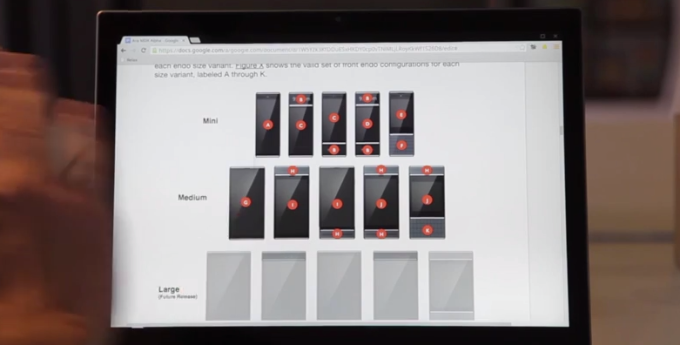
Plus, there’s a glimpse of how different size configurations of the modular device might look in terms of end-user design —  with phablet, standard and small handsets being specced out – albeit, in render form at this nascent stage:


The most interesting thing about the video — which very much has the feel of a crowdfunding pitch video you might find on Kickstarter or Indiegogo — is that Google is clearly continuing to put marketing muscle behind Project Ara to try to get outsiders excited about the prospect of a modular device.
It’s running a two-day developer conference for the device this month, which likely explains the release timing of this video.
The conference is the first in a series planned for this year, with the first event focusing on the alpha release of the Ara Module Developers’ Kit (MDK) — to get developers building Ara modules. More events are planned, so expect more details about Ara to keep dropping, piece by piece. source by TC.


FireChat for Android launched, lets users chat without a data connection


A new mobile messaging application called FireChat is empowering nearby smartphone users to stay in touch even when there's no cellular service or Internet connection.
In just two weeks since its release on the iPhone, FireChat already has provided a flicker of hope for people pining for more effective, secure and affordable ways to communicate. That's because the free messaging app harnesses a technology called wireless mesh networking, which might someday allow a myriad of devices to connect like links in a chain.
The technique might someday be used to tie together thousands of devices with built-in radios and make it possible to be online without having to pay for the access. It could also enable online communications in remote areas or disaster zones without Wi-Fi or cellular signals. Furthermore, the conversations in these so-called "off-the-grid" networks can't be easily hacked into by spies and mischief makers or shut down by governments trying to stifle free speech.
"We trying to create networks built by the people for the people," said Micha Benoliel, CEO of Open Garden, maker of the FireChat app.
Open Garden, a San Francisco startup with just 10 employees, is taking another step toward its ambitious goal with Thursday's release of a FireChat app for Android phones.
FireChat could be an even hotter commodity on Android given the demographic differences between that platform's user base and the typical iPhone owner. The app already has been installed on more than 1 million iOS devices.


Many smartphones running on Google Inc.'s free Android software are cheaper than Apple Inc.'s iPhone. That has made Android phones the top-selling mobile devices in less affluent countries, including in regions where Internet access is inadequate or expensive.
Google is among the big Internet companies intrigued with mesh networking's potential to bring more of the world online.
Sundar Pichai, Google's executive in charge of Android, has touted mesh networks as a way to connect wearable computers, such as the company's Glass eyewear. Mesh networks also could be used to bring a wide variety of everyday appliances online, helping to build an Internet of things instead of just websites.
FireChat's reach so far is limited. When connecting off the grid, iPhone app users have only been able to send text and photos to other FireChat users within a range of 30 to 100 feet.
Later this year, Open Garden plans to upgrade FireChat's iPhone app so off-the-grid users will be able to hopscotch through a daisy chain of devices to extend the reach of a local network. If this works, a FireChat user sitting in the right-field bleachers of a baseball game would be able to text with a friend on the other side of the stadium if enough other iPhone users in the ballpark also are on FireChat.
This extended range will be available immediately on FireChat's Android app because Open Garden released a mesh networking app for that operating system nearly two years ago.
FireChat's iPhone app piggybacks on an often overlooked feature called the Multipeer Connectivity Framework that Apple Inc. included in its latest mobile operating system, iOS 7, released last September. Apple says more than 80 percent of people using its mobile devices rely on iOS 7.
For now, Android phones and iPhones with the FireChat app won't be able to engage in off-the-grid conversation. Open Garden, though, believes it will eventually be able to make mesh networking work on phones running on different operating systems.
As the mesh networking software improved, Benoliel realized Open Garden needed to come up with application to demonstrate what the technology could do. In that practical sense, FireChat is similar to the word processing and spreadsheet programs that Microsoft released decades ago to help broaden the appeal of its Windows operating system for personal computers, said Christophe Daligault, Open Garden's marketing chief.
FireChat's development was driven by the popularity of other mobile messaging apps such as Snapchat and WhatsApp that enabled smartphone users to text and send pictures to their friends and family without having to pay smartphone carriers.
Like texts and photos sent on Snapchat, nothing transmitted through FireChat is saved. All content evaporates once the app is closed. FireChat also allows all its users to remain anonymous, another feature that is becoming popular on a variety of mobile messaging apps, such as Wickr and Rumr.
There still aren't enough people using FireChat to ensure users will find someone nearby to message. To pique people's interest in the app, FireChat offers an "everyone" option that allows users to enter a digital chat room with up to 80 other random users located in the same country. This option requires a Wi-Fi or cellular connection.
Dailigault concedes FireChat's chat room isn't as high-minded as mesh networking.
"We are finding a lot of people are using it when they are just looking for something to do for a few minutes," Dailigault said. "Some of the discussions there are turning out to be more interesting than anything they can find on Facebook."


FireChat lets you chat without a data connection


Move over WhatsApp. Here comes a revolutionary chatting app that has taken the mobile messaging to another level.
With this, you are able to send and receive messages even when you do not have an actual Internet or Wi-Fi data connection.
Yes, you read it right.
This iOS-enabled app uses Apple's Multipeer Connectivity framework essentially a peer-to-peer feature that lets you share messages with other app users nearby.
"FireChat allows the device to connect directly to others nearby using Bluetooth, peer-to-peer Wi-Fi or traditional Wi-Fi networks so you do not actually need a data connection," Micha Benoliel, CEO of Open Garden firm that developed the app was quoted as saying.
The Apple's Multipeer Connectivity APIs can be used for everything from collaborative editing and file sharing, to multiplayer gaming and sensor aggregation, said a report in wired.com.
How does it function?
The app browses for other users nearby while simultaneously broadcasting to peers that it is available to connect to. According to the company, this "Nearby" mode works best when the devices are within 30-feet.
This allows you to be invited into a "session" with multiple users. Each user has to be within range of just one member of the chat, so the mesh can spread outwards and cover a lot more range as more people join in.
Once a session invitation is accepted, you can directly communicate with those other users independent of a cellular signal or Wi-Fi access.
This creates what is called "wireless mesh network".
According to Benoliel, "Messages also get deleted as soon as you close the app so you remain anonymous."
However, in "Nearby" mode, you do not have any choice over who receives your messages they go out to anyone within range, the report added. There is also an "Everyone" mode, which sends the messages over a data connection so you can chat with friends who are not physically nearby. This is being segmented into chatrooms of 80 users each as the initial rush of downloads made it untenable to keep all users on a single chat.
Apple sold 700 million iOS devices by last October. Many are already using the latest Multipeer Connectivity-supporting version of iOS.
Within a week of its launch, FireChat has been being downloaded from the App Store more than 100,000 times a day. soource by NDTV.gadgets