welcome to TECHNO WORLD
Showing posts with label Computer updates. Show all posts

Monday, 5 May 2014

Get Started with Web Design Using Google Web Fundamentals - "How do I learn how to make websites?" - look around here for this Answer

"How do I learn how to make websites?"
I get asked this question regularly.
It’s a very simple question. Isn’t it? And I often feel like there should be a straightforward answer to it.
But the reality is it’s a tough question to tackle, so my response is always different. My answer varies depending on the asker’s background, learning style/preference, schedule, goals he or she would like to accomplish, financial restrictions, and so on.
That’s why I’m glad that trying to answer this question has become a whole lot easier.
Why?
Because I now have a reliable, free online resource I can point to that will help beginners get started quickly and easily.

Google Web Fundamentals is a free and open source project with the goal of educating people on how to build modern websites with best practices in mind.
Why is this resource so awesome?
Readability
You can probably finish the whole thing over a weekend even if you take your time. It’s not unnecessarily complicated with too much technical jargon, which I find often scares off aspiring web developers in a heartbeat. And there are plenty of useful screenshots, visuals and illustrations throughout the tutorials.
You’ll get something good out of it (aside from learning about web design)
There are code examples that you can use to build your first multi-device (responsive) web page.

Open source
Being open source guarantees transparency and quicker updates when things need to be edited or corrected (so it’s like a wiki governed by Google developers). If you’d like to contribute, check out the GitHub repo.

Quality-controlled
They even have style guides for maintaining and contributing to the project: See the visual style guidemarkdown guide and written style guide.

It’s backed by Google
The tech company everyone loves has a reputation for being an innovator in the web design/development space.
From here on out, whenever someone asks me "How do I learn how to make websites?" the first thing I’ll do is send them a link to Google Web Fundamentals.
After the person completes Google Web Fundamentals, I’ll ask if they’re still interested in moving forward with their web design/web development career because this resource will give them a quick taste (and positive first-impression) of what it means to build modern sites under the industry’s best practices.
Then, depending on what they were able to learn from Google Web Fundamentals, I might suggest a web design book or online course [ w3schools ] that will advance their knowledge and fill in the gaps.


Wednesday, 9 April 2014

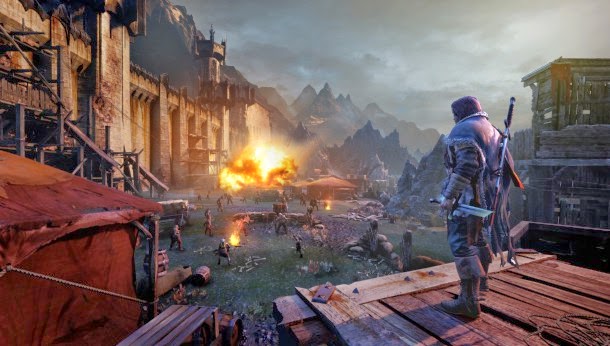
Middle-Earth: Shadow of Mordor system requirements are even higher than Watch Dogs


Do you remember Shadow of Mordor? You're forgiven if not, because, as generic fantasy names go, it's almost memorably unmemorable. If you need a refresher, the announcement trailer is an adequate primer for Warner Brothers' upcoming Assassin's Creed-meets-Lord of the Rings fantasy action-'em-up.
In preparation for its October release, a Steam listing has appeared. With it, are the game's PC system requirements. For those recently stung by Watch Dogs' high demands, these specifications may provide a familiar feeling of computational inadequacy.
Minimum: 
OS: 64-bit: Vista, Win 7, Win 8
Processor: Intel Core i5-750, 2.67 GHz | AMD Phenom II X4 965, 3.4 GHz
Memory: 4 GB RAM
Graphics: NVIDIA GeForce GTX 560 | AMD Radeon HD 6950
DirectX: Version 11
Network: Broadband Internet connection
Hard Drive: 25 GB available space
Recommended: 
OS: 64-bit: Win 7, Win 8
Processor: Intel Core i7-3770, 3.4 GHz | AMD FX-8350, 4.0 GHz
Memory: 8 GB RAM
Graphics: NVIDIA GeForce GTX 670 | AMD Radeon HD 7970
DirectX: Version 11
Network: Broadband Internet connection
Hard Drive: 40 GB available space
To compare, we're seeing a similar 64-bit OS restriction. And while the minimum RAM requirement is lower, the recommended GPU is higher; recommending the newer GTX 670, over Watch Dogs' suggestion of a GTX 560. source by pcgames
As with Watch Dogs, Shadow of Mordor is releasing on Xbox 360 and PS3 as well as PC and current-gen consoles. So while this is a good suggestion of where system requirements are heading, it's possible that the size of these games are still being set by the older hardware. As we move away from the last-gen, we should get an even better idea of the components needed to stay competitive.


Sunday, 16 March 2014

Download Beta VLC Player for Winodws - 8 & Windows 8 RT


VLC now available for Windows 8 one of the best multimedia players has finally come to Windows 8 and Windows 8 RT. A few hours ago that they have posted on the official blog announcing a beta version, but perfectly functional.

VLC for Windows 8 development has been paid thanks to a round of funding on Kickstarter that got nearly $80,000. The application is tailored to the interface ModernUI that characterized the new generation of Windows and can be downloaded directly from the app store.

The usual VLC in other systems notice less fluid than usual operation and some minor problems to work with subtitles, while taking into account that we are talking about a beta, developers work is more than notable. A year later, Windows 8 users can now enjoy great VLC. this is given in VLC's one of the blogpost

Today, the first Beta of VLC for WinRT is getting deployed on the store.
As many of you know, the road to come to this point has been long... Very long.
I've been driving or helping some ports of VLC on mobile, but this port has been the hardest, by an order of magnitude.
I'll speak a bit more about the lateness of this port, another time. Today, I'll introduce a bit to this application.

Features

This application, version 0.2.0, is a BETA stage of the port of libVLC on WinRT. WinRT is the runtime of Windows 8/8.1 Metro/ModernUI, Windows Phone 8 and Xbox 1.
As this is a beta, some features are still not perfectly stable, but we are working on that. We thought we should share it with the users, so that people could test and help us.
This application:
  • works on Windows 8.0 and 8.1: too many people are still on 8.0, so we had to use that. This decreases the stability of the application, though...
  • is compiled for Intel x86 CPUs: Windows RT version will follow as soon as we are able to compile it. ARM version will also apply to Windows Phone.
  • plays all video and audio formats of VLC, including MKV, Ogg and Mov files or FLAC and MPC;
  • supports the same codecs as the VLC application for desktop, from MPEG-1 to H.265, through WMV3 and VC-1;
  • supports multiple-audio tracks selection;
  • supports embedded subtitles;
  • supports Background Audio playback;
  • features a easy-to-navigate but complete UI, notably for audio browsing;
  • supports Live Tiles!
  • supports removable storage and DLNA servers.
However, there are a few limitations:
  • This app is currently slow, and is slower than VLC for desktop for video decoding and has no hardware acceleration;
  • Subtitles support is not very good yet, and notably it only supports embedded subtitles; this is our major point of focus for now.
  • Audio does not seem to work in all configurations;
  • Playlists and streams are not supported in the UI (they are present in the core)
  • It's clearly not as stable as it should be.
We are working on all those points, but notably on subtitles and audio quality and stability. Since we now have a release, it will be easier to do releases quite often, as soon as we can.
We also have longer terms goal to work on, and we'll share them when we know more :)
We hope you like this application, and if you don't, we'll fix that soon :) 

Download :


Friday, 17 January 2014

What is Malware ? and Types of Malicious Software's and Trojan Horse , Logic Bomb , Back Door or Trap Door , Virus, worm , rabbit, spyware, adware, Zombies of different virus and malware Documentation


What is Malware ? 

Malware is a malicious software. This software include the program
that exploit the vulnerabilities in computing system. The purpose of
malicious software is harm you or steal the information from you.


Types of Malicious


Softwares:

There are three characteristics of malwares:
1 Self-replicating malware actively attempts to propagate by creating
new
copies, or instances, of itself. Malware may also be propagated
passively,
by a user copying it accidentally, for example, but this isn't self-
replication.
2 The population growth of malware describes the overall change in
the number
of malware instances due to self-replication. Malware that doesn't
selfreplicate
will always have a zero population growth, but malware with a
zero population growth may self-replicate.
3 Parasitic malware requires some other executable code in order to
exist.
"Executable" in this context should be taken very broadly to include
anything
that can be executed, such as boot block code on a disk, binary code


Trojan Horse :


Self-replicating: no
Population growth: zero
Parasitic: yes
The most famous malicious software is Trojan
Horse.
There was no love lost between the Greeks and the Trojans. The
Greeks had
besieged the Trojans, holed up in the city of Troy, for ten years. They
finally
took the city by using a clever ploy: the Greeks built an enormous
wooden horse,
concealing soldiers inside, and tricked the Trojans into bringing the
horse into
Troy. When night fell, the soldiers exited the horse and much
unpleasantness
ensued.
In computing, a Trojan horse is a program which purports to do some
benign
task, but secretly performs some additional malicious task. A classic
example is
a password-grabbing login program which prints authentic-looking
"username"
and "password" prompts, and waits for a user to type in the
information. When
this happens, the password grabber stashes the information away for
its creator,
then prints out an "invalid password" message before running the real
login
program. The unsuspecting user thinks they made a typing mistake
and reenters
the information, none the wiser.


Logic Bomb:

Self-replicating: no
Population growth: zero
Parasitic: possibly
The oldest type of malicious software. This
program is embedded with some other program. When certain
condition meets, the logic bomb will destroy your pc.
It also crash at particular date which is fixed by attacer. It will be
included in legitimate or authorized person like this:
legitimate code
if date is Friday the 13th:
crash_computerO
legitimate code
Eg:
if some antivirus trying to delete or clean the logic bomb. The logic
bomb will destroy the pc.


Back Door or Trap Door :     


Self-replicating: no
Population growth: zero
Parasitic: possibly
A back door is any mechanism which bypasses
a normal security check. Programmers
sometimes create back doors for legitimate reasons, such as skipping
a time-consuming authentication process when debugging a network
server.
As with logic bombs, back doors can be placed into legitimate code or
be
standalone programs.
username = read_username()
password = read_password()
if tisername i s "133t h4ck0r":
return ALLOW^LOGIN
if username and password are valid:
return ALLOW_LOGIN
e l s e:
return DENY^LOGIN
One special kind of back door is a RAT, which stands for Remote
Administration
Tool or Remote Access Trojan, depending on who's asked. These
programs
allow a computer to be monitored and controlled remotely;


Virus:            

                                   
Self-replicating: yes                    
Population growth: positive
 Parasitic: yes                                           
A virus is malware that, when executed, tries to replicate itself into                  
other executable                                                
code; when it succeeds, the code is said to be infected. The infected
code, when run, can infect new code in turn. This self-replication into
existing
executable code is the key defining characteristic of a virus.


Types of Virus

1.Parasitic virus:
Traditional and common virus. This will be attached with EXE files
and search for other EXE file to infect them.

2. Memory Resident Virus:
Present in your system memory as a system program. From here
onwards it will infects all program that executes.

3. Boot Sector Virus:
Infects the boot record and spread when the system is booted from
the disk containing the virus.

4. Stealth Virus:
This virus hides itself from detection of antivirus scanning.


Worm:    

                                               Self-replicating: yes 

Population growth: positive                                       
Parasitic: no                                                              
A worm shares several characteristics with a        
virus


The most important characteristic                                
is that worms are self-replicating too, but self-replication of a worm
is distinct in two ways. First, worms are standalone, and do not rely on other                                          
executable code. Second, worms spread from machine to machine
across networks.                                                


Rabbit:

Self-replicating: yes
Population growth: zero
Parasitic: no
Rabbit is the term used to describe malware that multiplies rapidly.
Rabbits
may also be called bacteria, for largely the same reason.
There are actually two kinds of rabbit.The first is a program which tries
to consume all of some system resource, like disk space. A "fork
bomb," a
program which creates new processes in an infinite loop, is a classic
example
of this kind of rabbit. These tend to leave painfully obvious trails
pointing to
the perpetrator, and are not of particular interest.
The second kind of rabbit, which the characteristics above describe, is
a
special case of a worm. This kind of rabbit is a standalone program
which
replicates itself across a network from machine to machine, but deletes
the
original copy of itself after replication. In other words, there is only
one copy
of a given rabbit on a network; it just hops from one computer to
another.
Rabbits are rarely seen in practice.


Spyware:


Spyware is software which collects information
from a computer and transmits
it to someone else.
The exact information spyware gathers may
vary, but can include anything
which potentially has value:

1 Usernames and passwords. These might be harvested from files on
the
machine, or by recording what the user types using a key logger. A
keylogger
differs from a Trojan horse in that a keylogger passively captures
keystrokes
only; no active deception is involved.

2 Email addresses, which would have value to a spammer.

3 Bank account and credit card numbers.

4 Software license keys, to facilitate software pirating.
Definitions


Adware:


Self-replicating: no
Population growth: zero
Parasitic: no
Adware has similarities to spyware in that both
are gathering information about
the user and their habits. Adware is more
marketing-focused, and may pop up
advertisements or redirect a user's web browser to certain web sites in
the hopes
of making a sale. Some adware will attempt to target the advertisement
to fit
the context of what the user is doing. For example, a search for
"Calgary" may
result in an unsolicited pop-up advertisement for "books about
Calgary."
Adware may also gather and transmit information about users which
can be
used for marketing purposes. As with spyware, adware does not self-
replicate.


Zombies


Computers that have been compromised can be used by an attacker for
a
variety of tasks, unbeknownst to the legitimate owner; computers used
in this
way are called zombies. The most common tasks for zombies are
sending spam
and participating in coordinated, large-scale denial-of-service attacks.

Signs that your system is Infected by Malware:

Slow down, malfunction, or display repeated error messages
Won't shut down or restart
Serve up a lot of pop-up ads, or display them when you're not
surfing the web
Display web pages or programs you didn't intend to use, or send
emails you didn't write.


New ASUS ROG Poseidon GTX 780 graphic


The Taiwanese firm has announced the official launch of new graphics dedicated ASUS ROG Poseidon GTX 780, a model enthusiast with faster NVIDIA graphics chip and a specially designed hybrid cooling solution to reduce the temperature up to 140 percent and be three times quieter than the reference design, which adds a yield 12 per cent higher, according to the manufacturer.

The interest component of the ASUS ROG Poseidon GTX 780 is DirectCU H2O cooling system. A hybrid design which allows to dissipate via liquid and air temperature efficiently. The result is a reduction of the temperature to 24° c with respect to the design of reference and with the increase of yield referred to in games like Assassin completo Creed IV: Black Flag and BattleField 4.

Under the elite range ROG, the graph incorporates technologies ROG DIGI +, a few fans resistant to dust accumulation, Thermal Armor to improve the cooling of the MOSFET, Super Alloy, Black Metallic capacitors components, a design of power by 10 phases and the GPU Tweak utility for adjusting graphics performance and reproduction of games live via streaming.


A DIGI + VRM with 10 supply phases of Super Alloy Power, Black metallic capacitors manufactured in Japan, most use and temperature-resistant Super Alloy Power choke and a MOSFET coils, show the level of a graph that includes functions such as GPU Tweak which allows you to make the most of the potential performance of the GPU using controls as the setting of the clock speed, and the voltage of the GPU and video memory, the fan speed and energy consumption thresholds.

Specifications ASUS ROG Poseidon GTX 780

Graphics engine: NVIDIA GeForce GTX 780
Bus: PCI Express 3.0
Core frequency: up to 1006 MHz
Memory frequency: 6008 MHz (1502 MHz GDDR5)
Installed memory: 3 GB GDDR5
Memory interface: 384 bits
CuDA cores: 2304
Outputs: DVI-D, DVI-I, HDMI, Display Port
Consumption: Up to 300 Watts


Intel prepares Haswell renewal and Refresh processors for 2Q14 with 20 new processors


Intel prepares the renewal of Haswell with 20 new processors for desktop computers, including models Celeron, Pentium, Core i3, i5, and new top of range of series: Core i7-4790.

Which Intel marketed this spring (shipments in April 2014) are at least 20 different SKUs. No improvements in the overall architecture of the originals presented at Computex last in sight.

They will use the current socket LGA 1150 and although the launch of new chipsets Z97 and H97 is planned, will be compatible with motherboards today, surely with a simple BIOS update.


Listed models include :-  
 
  •  Core i7-4790 
  •  Core i5-4690 
  •  Core i5-4590 
  • Core i3-4360 
  •  G3450 Pentium Celeron G1840,  and


 versions of low-power :- 
  •  Core i7-4790S 
  •  Core i5-4590S 
  •  Core i3-4150T.


To highlight the new top of range of Haswell platform, Core i7-4790. A micro-processor with four cores and eight threads of native processing, frequencies of 3.6 to 4 GHz, 8 MByte of third level cache, graphics integrated Intel HD 4600 frequently maximum core-to 1200 MHz and a controller for DDR3 memory up to 1600 MHz.

Remember that since the launch of the Haswell last summer, Intel has updated the series with models such as the Celeron G1820, G1820T and G1830, the cheapest you'll find with the most advanced Intel architecture and between 48 and 56 dollars selling prices which focuses them to basic desktop PCs, mini-PCs or computers for home theater.

Already in the third quarter, we will have the renewal of the ' k ' of the Haswell versions with unlocked multiplier. On another level, also the Haswell-E, the first processors of the firm for the consumer sector with 8 physical cores and 16 threads of native  Processors 

And also 

Intel's next-generation Haswell Refresh processors are expected to become available in the retail channel in May, and the CPU giant will also start shipping its Z97 and H97 chipsets in April in order to enable motherboard players such as Asustek Computer and Gigabyte Technology to start selling related products at the end of the month.

Intel will then release its Haswell Refresh K series and Haswell-E in the third quarter and phase out its 

•  Core i5-3350P 

•  Core i3-3225  and

•  Core i3-3210 processors in the first quarter.


Microsoft to employ Halo voice actress for Siri rival, and also to to bring Cortana voice-assistant with Windows Phone 8.1 in April .report says


Jen Taylor, who played the role of AI character Cortana in the Halo video game series, will reportedly be the voice for Microsoft's personal assistant, set for a beta release on Lumia devices in April.


Video game fans became giddy last fall upon hearing that Microsoft was developing a Siri competitor for Windows Phone code-named Cortana, after the AI companion of protagonist Master Chief in the Halo series. Now, it looks like Microsoft is going all in on that sci-fi vision for its personal assistant: Jen Taylor, the actress who played Cortana, is onboard to become the voice behind the information service, Microsoft blog MSFTnerd reported Thursday.

Little else has been dug up regarding the progress of the Cortana project or its arrival other than that it would likely come in one form or another with Windows Phone 8.1 sometime in early 2014. MSFTnerd is claiming as much, slating a Cortana beta launch on Lumia devices for this April, which coincides with Microsoft's annual Build conference in San Francisco.
MSFTnerd is also saying that Cortana will make its way to the Bing app for iPhone this fall and American Xbox One and Windows users in 2015 with the release of Windows Threshold, Microsoft's next-generation OS currently in the works.

With the rise of personal assistants like Siri and more ambitious plans to weave them into much more than our phones -- as Google is doing with Google Now -- it's no wonder Microsoft is trying to differentiate its service with a pop-culture staple and a commitment to making it as true-to-the-original as possible.
And with films like Spike Jonze's "Her" popularizing the notion that our personal computing futures will be abound in human-like AI companions, a personal assistant with a distinct name, recognizable voice (at least to gamers), and well-developed personality thanks to multiple Halo releases has an undeniably cool factor. While it may not create an excess of Windows Phone converts, it will certainly influence the AI landscape if it does in fact arrive soon on desktops andtablets with Windows Threshold.
Earlier this month -- when Microsoft announced that the Xbox One had surpassed 3 million units in sales -- it omitted Halo when discussing upcoming Xbox One titles to celebrate. That caused many fans to bemoan the wait for what is presumably Halo 5, a flagship Xbox One title that currently has one ambiguous trailer, shown last May, to its name. A Microsoft PR spokesperson quickly confirmed that Halo would in fact be arriving by the end of the year.
As the Cortana personal assistant is built out, and most likely retains that moniker from code-named beta to full-fledged service, we can only assume that the Halo series and its iconic characters will become an even larger cornerstone of Microsoft's greater voice and AI efforts in 2014. Though for those privy to the Halo universe and the nature of Cortana's character, it will surely be interesting to see how Microsoft juggles the rollout of its service alongside this new Halo release and its potential plot points.


Additional information has reportedly been revealed about Microsoft's rumoured voice-assistant expected to act as Siri's counterpart in Windows Phones - Cortana.
According to MFSTNerd, the Twitter handle of a purported Microsoft source, the proposed voice-assistant is said to reach Nokia Lumia models by April this year and will be voiced by Halo's Jen Taylor, who is the voice behind the game's artificial intelligence (AI) character, Cortana.
Microsoft has been rumoured to be working on its voice-assistant feature since September, based on the character of the firm's own published gaming title.
The rumoured app made its first appearance back in September 2013, when screenshots of an early Windows  Phone build leaked online, listed as 'zCortana'. Reports by The Verge also showed some screenshots of Cortana which indicated that the service will offer weather information, notifications, and calendar, in addition to alarms and phone calls. The screenshots also indicated that the app will be location-aware, as well.
It has been also speculated that Cortana might arrive with the latest Windows Phone 8.1 OS for smartphones. Last month's report revealed that the Redmond-based company is gearing up to ship itsupcoming Windows  Phone 8.1 with two new features - a notification centre that can be accessed by swiping down from top of the screen, just like Android and iOS, apart from a voice-based assistant believed to be codenamed 'Cortana'.
It's worth pointing out that Windows  Phone already offers the TellMe voice-based assistant, although it's nowhere close to Apple's Siri or Google Now in terms of functionality and accuracy. It is yet to see what Cortana has in store for the Windows  Phone users.